
No. Ontario has no rebate for a home EV charger in 2026. The province ended its home charging station rebate in 2018, and nothing has replaced it. Two things do exist. A federal incentive of up to $5,000 comes off the price of the car at the dealership, and a private program gives away the charger itself. Neither one pays an electrician, which is why how expensive it is to install an EV charger is the number to plan around.
What we checked, and what each program covers
Barrie Electrical Co. gets the rebate question on nearly every charger call. This is the list as it stood in September 2026, taken from each program’s own page.
| Program | What it pays toward | Pays for a home install? |
|---|---|---|
| Ontario home charging station rebate | Ended in 2018 | No |
| Federal Electric Vehicle Affordability Program | The car, at the dealer | No |
| Zero Emission Vehicle Infrastructure Program (federal) | Workplaces, public sites, fleets; applications closed | No |
| ChargeON (Ontario) | Public charging in communities; applications closed | No |
| Home Renovation Savings (Enbridge Gas and Save on Energy) | Heat pumps, insulation, windows, solar and storage | Chargers are not on its list |
| SWTCH Home Charging Program | A free Level 2 charger, then payments per kWh | Charger only |
Toronto homeowners have one more line: a low-interest loan through the city’s Home Energy Loan Program. It is a loan, not a grant, and it stops at the Toronto boundary. We know of no equivalent in Barrie or the surrounding townships.
The federal money sits on the car
The Electric Vehicle Affordability Program started taking claims in 2026 and runs to March 31, 2031, or until its funding is spent. It pays up to $5,000 on a battery electric car and up to $2,500 on a plug-in hybrid. You cannot apply for it yourself. The dealer checks that you and the car qualify, and the amount comes straight off the bill of sale.
Three details matter to anyone also planning a charger:
- The amount drops each year. The 2027 level for a battery electric car is $4,000, and the date that counts is when the dealer submits the eligibility check, not when you signed.
- A charger bundled with the car does not count against the cap. Transport Canada lists the Level 2 charger and adapters among the items left out of the $50,000 final transaction value. A dealer package with a charger in it does not push an eligible car over the line.
- It is one incentive per person. An individual can receive it once for as long as the program runs.
So the rebate on the car is real, and it lands before you drive home. It does nothing for the circuit in your garage.
A free charger still needs a paid circuit
The SWTCH Home Charging Program is the closest thing to a charger rebate available to a house in this area. It pays out of carbon credits under the federal Clean Fuels Regulations, not out of a government budget. The terms on its own store page, read this week:
- A $300 deposit and a $30 shipping fee. The deposit comes back after 1,500 kWh of charging.
- 3 cents per kWh until you reach 1,500 kWh, then 11 cents per kWh after that, paid in $100 amounts.
- A choice of a NEMA 14-50 plug at 40 A or a hardwired unit at 48 A. That’s the hardwired vs plug-in EV charger call, and you make it before you order.
- The charger has to reach your home Wi-Fi through the program’s app before it earns anything.
The installation is on you. That choice between 40 A and 48 A is where a Barrie house can come unstuck. The 48 A hardwired version is the bigger load, and on an older service it is the one more likely to fail the Section 8 calculation. Before you pick a model, read how we size a 100 amp service for an EV charger, because the answer may be a load management device rather than a new service.
The Wi-Fi point matters most on a detached garage. A charger that cannot hold a connection at the back of the lot earns nothing, so check the signal where the charger will hang before you order one.
Why our quotes never show a rebate line
Our EV charger installation in Barrie is priced at $800 to $1,500 plus the charger, for a typical attached-garage run. That figure is the same whether the charger came from a dealer, a store or a free program, because the work is the same: a dedicated circuit, the breaker, the wire run and the EV charger permit in Ontario.
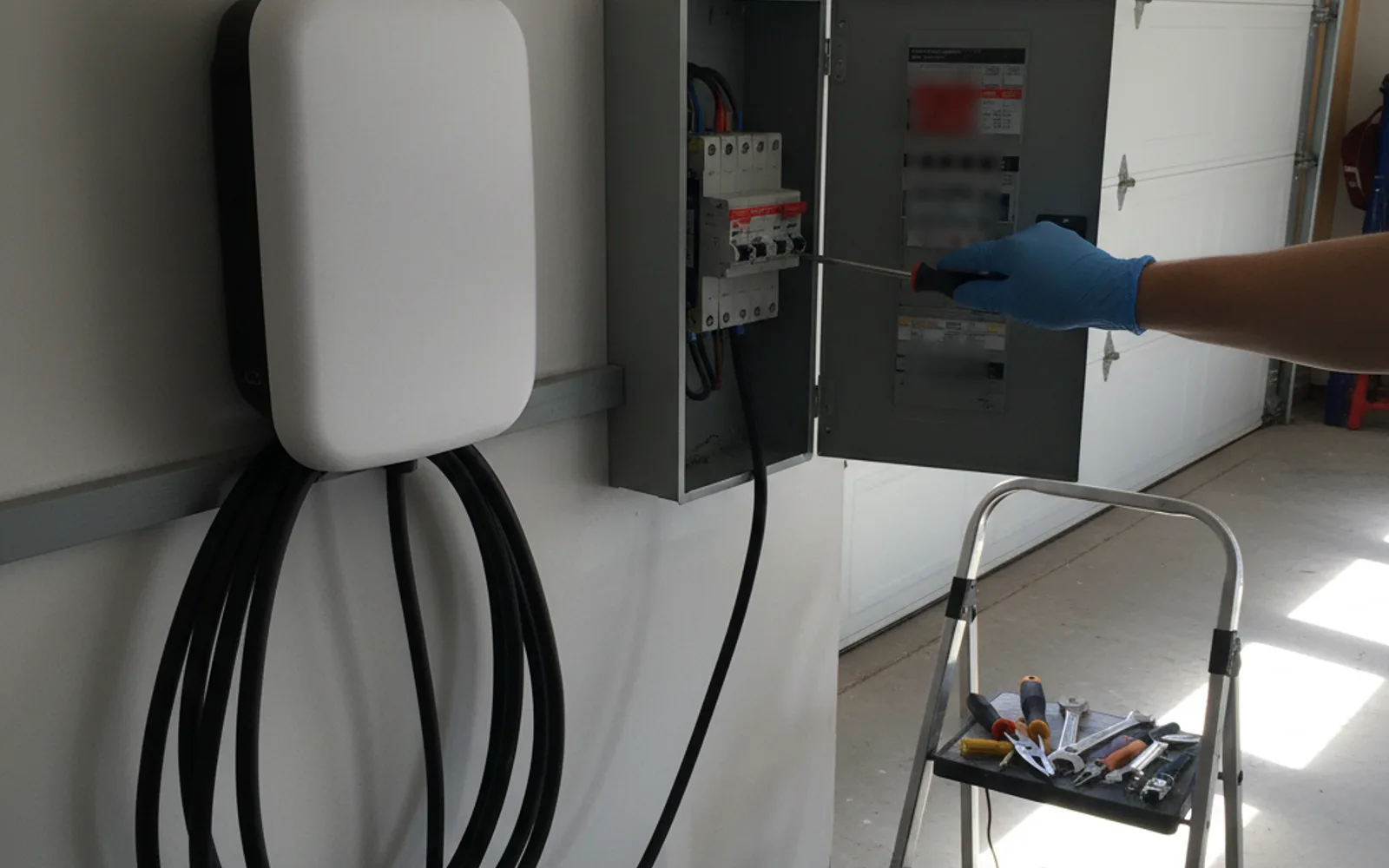
We do not print a price with a rebate taken off. A program can close between the quote and your application, and several Ontario ones already have. If a quote only works with a rebate subtracted, ask what the number is if the program says no.
The permit is part of that figure, not an extra. What the notification costs and why it matters on resale is set out in our guide to the ESA inspection cost in Ontario.
If a heat pump rebate is in the same plan
Home Renovation Savings does not pay for a charger, but it does pay for heat pumps, up to $12,000 on its current list. Owners who are adding both in the same year should size them together. A heat pump with no gas furnace behind it and a Level 2 charger both land on the same service, and running the load calculation twice, a year apart, is how a house ends up with a charger install and then a surprise panel upgrade in Barrie the following spring.
Ask for one calculation that includes both loads. If the service passes with both, you know. If it does not, you can choose a load management device or an upgrade once, and time the heat pump rebate application around the work.
Where to start
If the free charger is the plan, confirm the service first and order the charger second. If the plan is to wait and see whether the car covers your week on the cord it came with, a Level 1 EV charger plugged into its own circuit is the cheaper test. Either way, the rebate question has a short answer in 2026: the money is on the car, the charger can be free, and the installation is yours to budget in full.